
Turkey
Last updated: 12 April 2026
At a glance
Turkey's mediterranean coast runs from the Aegean sea to the Gulf of Antalya where it borders with Syria. The main sailing grounds are concentrated in the southwest, between Bordum and Kas, where a well-developed infrastructure of marinas and boatyards supports a large volume of visiting and liveaboard yachts.
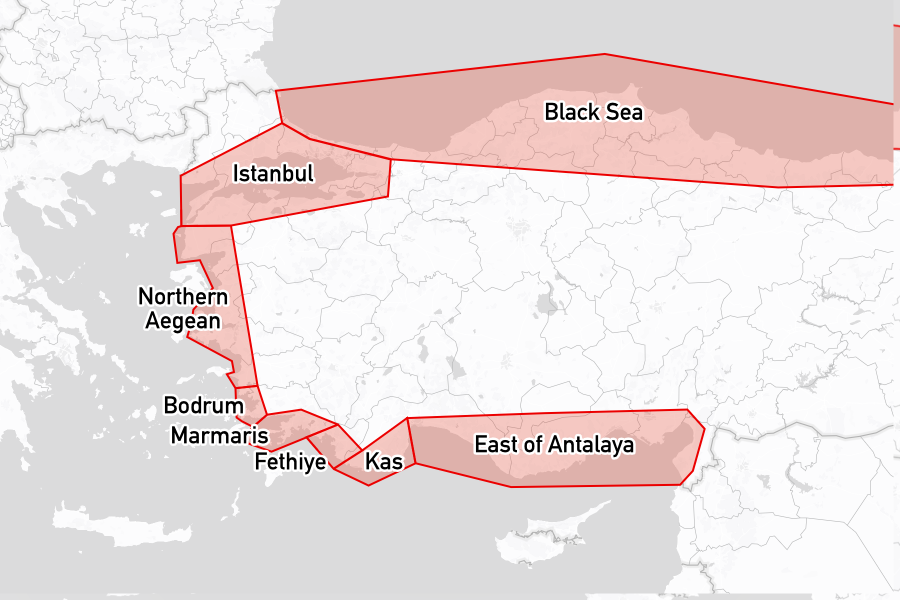
Explore sailing areas
Our sailing area guides contain the most useful information for cruisers, including top-rated places to stay, attractions, yacht services, and summaries of yacht clearance experiences.
- The Black Sea Offers a remote cruising experience with unspoiled natural scenery and few services.
- Istanbul and The Sea of Marmara Functions as a busy hub connecting the Black Sea to the Aegean and Mediterranean seas.
- The Northern Aegean Coast Known for historical sites and fewer tourists compared to other regions.
- Bodrum Peninsula Renowned for its vibrant nightlife, tourist facilities, and protected anchorages.
- Marmaris and Datça Peninsula Features beautiful bays and reliable marine services, appealing to cruising sailors.
- Fethiye and Göcek Gulf Popular for its stunning coves and well-established sailing community.
- Kaş and Kekova Offers a mix of ancient ruins and picturesque sailing grounds.
- East of Antalya Characterized by secluded anchorages and natural beauty.
Yacht clearance and notes for mariners
See the relevant sailing area page above for details.
The off-season
Many Turkish marinas offer haul-out and storage. For those wishing to live aboard, options include: Setur Finike Marina, Yacht Marina Marmaris. Further afield Messolongi in Greece, Marina di Roccella in Italy, and Portonovi Marina in Montenegro are good options too.
Facts for visitors
- Best times of year to sail here: May to October, with June and September offering the best balance of conditions and crowds
- Most common type of shore power: 220V 50Hz
- Cost for provisioning: Low
- Currency: Turkish Lira (TRY)
- Personal security: Coastal sailing areas are generally safe for visitors. Those cruising east of Antalya should check current government travel advice regarding the Syrian border region
- Emergency phone numbers:
- Police: 112 (or 155)
- Fire: 112 (or 110)
- Ambulance: 112
- Coast Guard: 158
- International dialing code: +90
- Time zone(s): UTC+3 (no daylight saving observed)
Maritime history
The Turkish coast has a long history of maritime activity, shaped by its position at the intersection of Europe, Asia, and the Middle East. Greek and Roman ports once lined the Aegean and southern shores, and the region's natural harbours supported trade routes connecting the eastern Mediterranean for centuries. Many of these ancient sites remain visible today along the cruising coast.
Constantinople, now Istanbul, sat at the crossroads of the Aegean and Black Sea, and whoever controlled the Bosphorus controlled the passage between them. The Ottoman Empire, which held the city from 1453, built a powerful navy and used it to dominate eastern Mediterranean trade and conflict for several centuries. The empire's influence over regional sea routes remained significant well into the 18th century.
As Ottoman power declined through the 19th century, Turkey entered the First World War in 1914 on the side of Germany and Austria-Hungary. The following year, Allied forces launched a major naval campaign to open a supply route to Russia through the Dardanelles strait. The operation, fought on the Gallipoli peninsula, ended in Allied withdrawal after eight months of heavy casualties on both sides. In the Second World War, Turkey remained neutral, but its control of the Bosphorus and Dardanelles made it a significant strategic concern for both the Allied and Axis powers throughout the conflict. Turkey formally joined the Allies in February 1945.
The modern Turkish coast is primarily tourism-driven. The gulet, a style of wooden motor-sailer typically associated with traditional Turkish boat building, is in fact a modern design developed in the Bodrum boatyards in the early 1970s to serve the growing tourism market. Today the southwest coast supports one of the largest cruising industries in the Mediterranean, with Bodrum, Marmaris, Fethiye, and Göcek among the main bases.