
Morocco
Last updated: 10 April 2026
At a glance
Morocco sits at the western entrance to the Mediterranean, straddling two distinct coastlines. The short Mediterranean coast runs from the Algerian border to the Strait of Gibraltar, with Tangier at its western end. The longer Atlantic coast extends south from the Strait for over 1,000 NM, reaching beyond Agadir towards the Western Sahara.
The two coasts offer contrasting sailing conditions. The Mediterranean shore is compact and sheltered by comparison, while the Atlantic presents exposed ocean conditions.
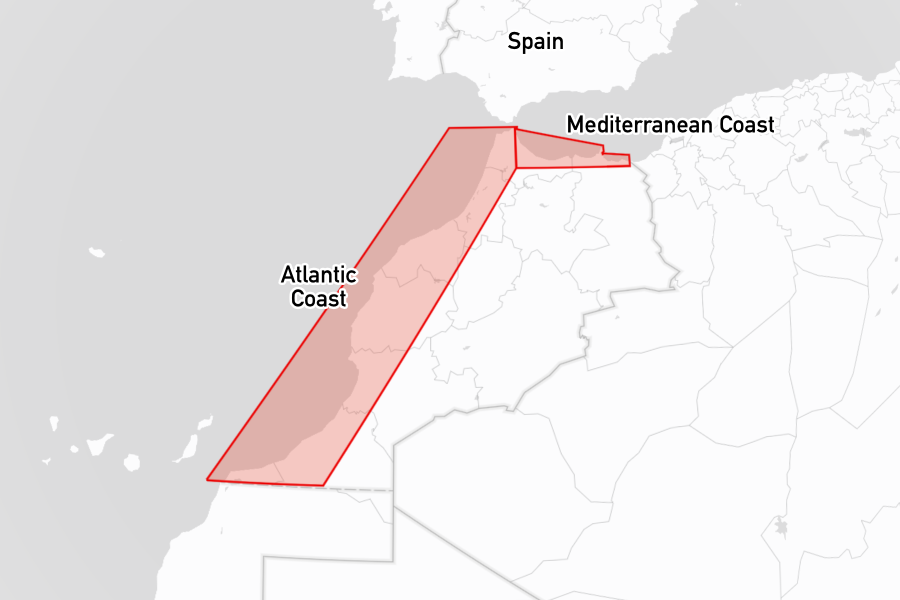
Explore sailing areas
Our sailing area guides contain the most useful information for cruisers, including top-rated places to stay, attractions, yacht services, and summaries of yacht clearance experiences.
- Atlantic Coast Attracts sailors with scenic coastlines and several informal anchorage options.
- Mediterranean Coast Popular for its favorable winds and cultural experiences along the shoreline.
Yacht clearance and notes for mariners
See the relevant sailing area page above for details.
The off-season
Liveaboard sailors in the Mediterranean tend to gather in sociable winter marinas. Some nearby options for Morocco include: Tanja Marina in Tangier, Morocco; Almerimar and Yacht Port Cartagena in Spain; and Albufeira Marina and Marina de Lagos in southern Portugal.
Facts for visitors
- Best times of year to sail here: April to June and September to October offer the most settled conditions; summer brings strong north-easterlies on the Atlantic coast
- Most common type of shore power: 220V 50Hz
- Cost for provisioning: Low
- Currency: Moroccan Dirham (MAD)
- Personal security: Petty crime and scams are common in tourist areas; occasional violent crime is reported in cities; terrorism remains a general threat
- Emergency phone numbers:
- Police: 190
- Gendarmerie (outside cities): 177
- Ambulance: 150
- Fire: 15
- International dialing code: +212
- Time zone(s): UTC+1 year-round, except during Ramadan when clocks revert to UTC+0
Maritime history
Tangier was known to Phoenician and Carthaginian sailors by at least the 5th century BC, later becoming the capital of the Roman province of Mauretania Tingitana. Arab conquest in the 7th century brought Morocco into a wider Islamic maritime world, and by the 16th century the port of Salé had become the principal base for the Salé Rovers, a corsair confederation that raided as far as Iceland and the British Isles. The same era produced one of Morocco's most enduring diplomatic footnotes: in 1777 Sultan Mohammed III declared American merchant vessels protected in Moroccan waters, and the Moroccan-American Treaty of Friendship signed in 1786 remains the oldest unbroken friendship treaty in United States history.
Ceuta and Melilla, both on the Moroccan Mediterranean coast, were fortified as strategic naval and commercial outposts by Portugal and Spain respectively in the early 16th century. Their purpose was to control access to the western Mediterranean, protect Iberian shipping lanes, and project power into North Africa. Both cities passed to Spain and remain Spanish sovereign territories today. Their fortifications, much of which survive, reflect the intense European competition for control of the strait during this period.
The French and Spanish protectorates established in 1912 brought Morocco's major ports under European administration. Casablanca was developed as the principal commercial harbour, with regular maritime services connecting it to Marseilles. Morocco's independence in 1956 was followed by sustained investment in port infrastructure, and today Tangier, Rabat, and Agadir all offer facilities for visiting yachts, with the country firmly established on the cruising route between Europe and the Atlantic.