
Croatia
Last updated: 4 April 2026
At a glance
Croatia extends along the eastern Adriatic coast, where a deeply indented shoreline and a chain of over a thousand islands create some of the most varied cruising in the Mediterranean. The coastal geography ranges from sheltered passages between long parallel islands to open crossings and exposed headlands, with distances between destinations generally short. Infrastructure for visiting yachts is well developed along the entire coast, with marinas, provisioning, and repair facilities widely available.
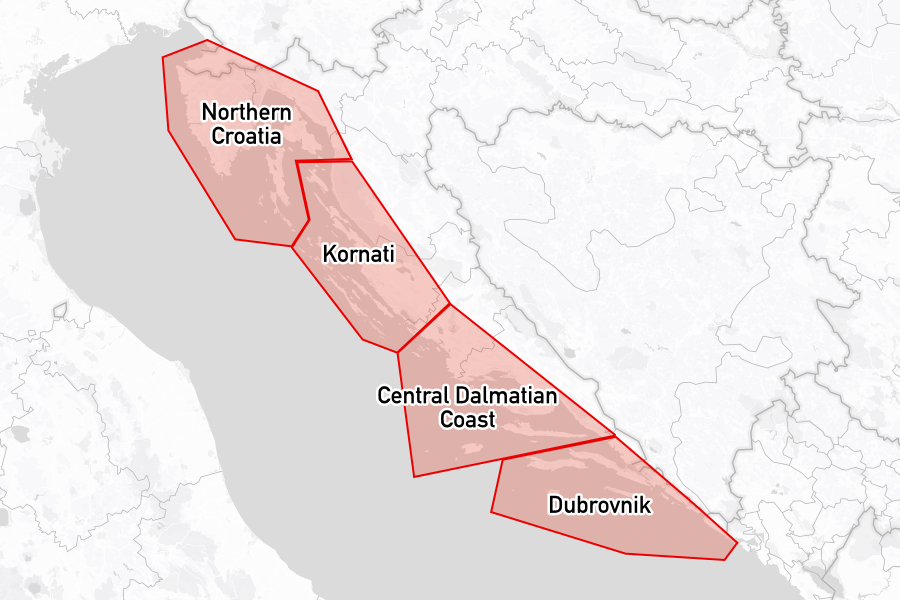
Four broad cruising areas cover the country from north to south: Northern Croatia, taking in Istria and the Kvarner Gulf; the Kornati archipelago and surrounding waters; the Central Dalmatian Coast around Split and Šibenik; and the southern coast leading to Dubrovnik.
Explore sailing areas
Our sailing area guides contain the most useful information for cruisers, including top-rated places to stay, attractions, yacht services, and summaries of yacht clearance experiences.
- Northern Croatia Visited for its serene coastline and accessible islands.
- Kornati Home to numerous islands offering diverse exploration opportunities.
- Central Dalmatian Coast Attracts sailors with its historical towns and cultural heritage.
- Dubrovnik Famous for picturesque views and vibrant cultural events.
Yacht clearance and notes for mariners
See the relevant sailing area page above for details.
The off-season
Croatia has well-established facilities for winter storage across its main cruising areas. Liveaboard sailors in the Mediterranean tend to gather in sociable winter marinas. Croatian coastal areas become quiet over the winter months, though some towns retain a degree of life year-round. One such place for overwintering is Marina Frapa in Rogoznica. Options outside of Croatia include: Lazure Marina & Hotel, Montenegro, Portonovi Marina, Montenegro, Marina di Brindisi, Italy, and Preveza Marina, Greece.
Facts for visitors
- Best times of year to sail here: May to October
- Most common type of shore power: 230V 50Hz
- Cost for provisioning: Medium
- Currency: Euro (EUR)
- Personal security: Low crime rate; petty theft is the primary concern in busy tourist areas during the summer season
- Emergency phone numbers:
- European emergency line (available 24/7, free, English-speaking): 112
- Police: 192
- Ambulance: 194
- Fire: 193
- Coast Guard: 195
- International dialing code: +385
- Time zone(s): UTC+1 (UTC+2 during daylight saving, last Sunday in March to last Sunday in October)
Maritime history
Croatia's Adriatic coast has been a maritime thoroughfare since antiquity. The Illyrians, whose tribes occupied much of the eastern Adriatic littoral, were seafarers known for fast galleys and, according to Roman sources, widespread piracy that ultimately provoked Roman military intervention in the late 3rd century BC. Greek colonies had earlier established trading settlements along the coast, with Vis home to the ancient Greek colony of Issa, serving as a commercial and navigational hub in the central Adriatic.
Under Roman and later Byzantine rule, the Dalmatian ports functioned as staging points for fleets operating across the Adriatic. The city of Zadar served as the administrative capital of Byzantine Dalmatia, and the coastal towns maintained active commercial ties with both the eastern and western Mediterranean. Following the fragmentation of Byzantine authority, Venice came to dominate much of the Dalmatian coast from the early 15th century, integrating the region's harbours and shipbuilding capacity into its own maritime empire. Timber from the Dalmatian hinterland and the islands supplied Venetian shipyards for centuries.
The 19th century brought the coast under Austrian Habsburg administration, which invested in port infrastructure and supported the growth of a merchant fleet operating under the Austrian flag. Rijeka (then Fiume) developed as a significant commercial port, and Dalmatian sailors and shipbuilders earned a wide reputation across the Mediterranean trade. The transition to steam reduced the comparative advantage of Dalmatian sailors, but the region continued to contribute substantially to Austro-Hungarian maritime commerce until the end of the First World War.
Contemporary Croatian waters are among the most actively sailed in the Mediterranean, with a charter industry centred on Split and a network of marinas developed substantially from the 1970s onward. The Kornati archipelago gained national park status in 1980, and the broader coastline continues to attract a large volume of international cruising yachts alongside commercial shipping using the ports of Rijeka, Split, and Ploce.