
France
Last updated: 5 April 2026
At a glance
France's Mediterranean coast divides into two contrasting cruising regions. East of the Rhône delta, the Côte d'Azur is the more glamorous stretch of coast taking in Nice, Cannes and Monaco, with a well-developed infrastructure for visiting yachts and superyachts alike. To the west, the Golfe du Lion presents a flat, low-lying coastline of long sandy beaches, shallow lagoons, and large commercial and fishing ports.
The Rhône delta itself marks the principal entry point to the French inland waterway network, connecting the Mediterranean to the canal system that traverses the country and leads both to the Atlantic coast via the Canal du Midi and to northern Europe via the Rhône, Saône, and Rhine.
Corsica is a large island destination, closer to the Italian mainland than to France, offering modern marinas and hundreds of bays to stay in at anchor.
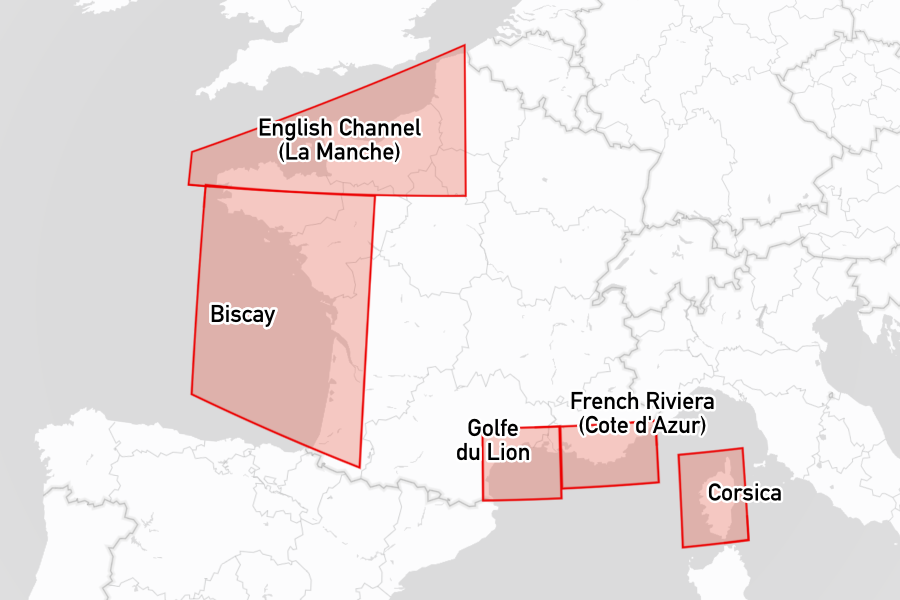
Explore sailing areas
Our sailing area guides contain the most useful information for cruisers, including top-rated places to stay, attractions, yacht services, and summaries of yacht clearance experiences.
Yacht clearance and notes for mariners
See the relevant sailing area page above for details.
The off-season
Many French Mediterranean marinas offer haul-out and storage for the off-season. For liveaboard sailors seeking an active winter sailing community some nearby options include Port Ginesta in Spain, Almerimar in Spain, and Marina di Ragusa in Italy.
Facts for visitors
- Best times of year to sail here: May to October
- Most common type of shore power: 230V 50Hz
- Cost for provisioning: Medium
- Currency: Euro (EUR)
- Personal security: Generally safe for visitors, with petty theft a concern in busy tourist areas
- Emergency phone numbers:
- Police: 112
- Ambulance: 112
- Fire: 112
- Coast Guard: 196
- International dialing code: +33
- Time zone(s): UTC+1 (UTC+2 during daylight saving)
Maritime history
France's maritime expansion began in earnest during the 15th and 16th centuries, when Breton and Norman sailors ventured into the North Atlantic in search of new fishing grounds and trade routes. Jacques Cartier's voyages of the 1530s established French claims in North America, and the port of Saint-Malo became a significant base for transatlantic expeditions. French interest in the Americas, Africa, and Asia grew steadily over the following century, laying the foundations for a colonial empire that would eventually span five continents.
The 17th and 18th centuries saw France develop into a major naval power, with Colbert's reorganisation of the navy under Louis XIV establishing a professional fleet capable of contesting control of Atlantic and Mediterranean waters. French colonial ambitions brought it into prolonged conflict with Britain and the Netherlands, and the period saw major naval engagements across the Atlantic, Indian Ocean, and Caribbean. The loss of much of French North America following the Seven Years War marked a significant setback, though France retained substantial colonial holdings in the Caribbean, Indian Ocean, and West Africa.
The Revolutionary and Napoleonic periods brought further naval conflict, culminating in the defeat at Trafalgar in 1805 which effectively ended French ambitions for naval supremacy. Despite this, France rebuilt its colonial presence through the 19th century, establishing control across large parts of West and North Africa, Southeast Asia, and the Pacific. Ports such as Marseille, Bordeaux, and Le Havre grew into major commercial hubs sustained by colonial trade, and the French merchant marine expanded significantly during this period, with the Caribbean remaining one of the most important theatres of French maritime activity throughout the 19th century.
France today retains overseas territories across the Atlantic, Caribbean, Indian Ocean, and Pacific, several of which are significant cruising destinations in their own right. The French navy remains one of the largest in Europe, and recreational sailing is deeply embedded in French coastal culture, with a large domestic fleet and a strong tradition of offshore and ocean racing.