
Albania
Last updated: 6 June 2026
At a glance
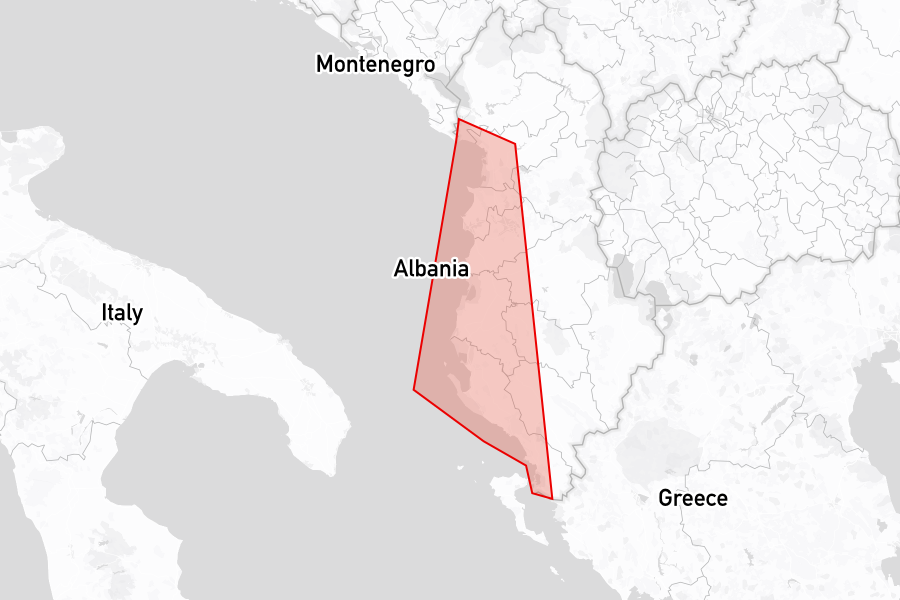
Albania's coastline extends approximately 350 kilometres along the Adriatic and Ionian seas, running from Montenegro in the north to Greece in the south. The two stretches have markedly different characters: the Adriatic shore to the north is lower-lying, more exposed, and dominated by commercial port traffic centred on Durrës, while the Ionian coast from Vlorë southward offers clearer water, a more rugged landscape, and the majority of interest for visiting yachts.
Yachting infrastructure is limited compared with neighbouring Greece and Montenegro, and the southern coast offers unspoiled anchorages and access to some of the most significant ancient sites in the Balkans.
Attractions
The Ottoman-era Ali Pasha's Fort sits at the water's edge in the well-protected bay of Porto Palermo on the Ionian coast. The triangular castle was built in the early 19th century and information boards inside cover its history in English. A music festival runs at the site for several weeks in July and August.
A short distance south of Sarandë, Butrint is one of the most rewarding ancient sites in the Balkans. Set on a forested peninsula between the Vivari Channel and Lake Butrint, the UNESCO World Heritage Site preserves successive layers of Greek, Roman, Byzantine, and Venetian occupation, including a well-preserved Greek theatre, a late-antique baptistery, and fortifications spanning more than a millennium. An exceptional museum on site draws together finds from across the excavations.
From the port of Durrës, many crews make the trip inland to Tirana. The capital is walkable and extensively regenerated, with green spaces, good food, and a lively café culture. Bunk'Art, a museum built inside one of the thousands of concrete bunkers constructed during the communist era, offers a frank account of that period of Albanian history.
Places to stay
Below are the most popular and highly rated places to stay, based on reviews from the noforeignland community:
Anchorages

|
Butrint
★
4.4
Depths in the channel are consistently over 5 meters. Multiple reviewers appreciate the peaceful environment and good holding conditions. Visitors report successful anchoring, though some caution regarding the approach from local boats is advised.
|

|
Orso Bay
★
4.3
The anchorage features clear water and provides protection from swell. Depths in the charts may not be accurate, complicating anchoring for larger crafts due to limited space. Ideal conditions and calm weather are essential for successful stays.
|

|
Kakomea Bay
★
4.2
The anchorage at Kakomea Bay offers a peaceful setting with good holding in sand at 8 meters. While the area is bustling with boats during the day, it becomes tranquil by evening. Clear waters provide good swimming, though concerns persist about waste from nearby fish farms.
|

|
Vlore
★
3.8
Conditions can be rolly, particularly in heavier weather, but holding is reliable in shallower depths. A new dinghy pontoon has been installed, improving access. The city offers various provisioning options, though noise from traffic can disrupt daytime peace.
|

|
Ksamil North
★
3.7
Good holding is reported, though vessels may encounter weed when anchoring. Visitors noted noise from jet skis and boats, especially during the day. The location provides a calm environment at night, with helpful locals managing dinghies.
|

|
Sarandë Port
★
3.6
Busy anchorage with limited space and strong swells reported. Many visitors highlighted Jelja's efficiency for check-in and services. Loud music and party boats contribute to an active environment, which may be a concern for some boaters.
|

|
Durres
★
3.3
Anchoring in Durrës offers good holding in shallow depths, with protection from northern and western winds. Access to town is possible by dinghy, though landing is difficult due to rocky shorelines. Supplies and services are adequate, with a straightforward clearance process.
|

|
Ftelias
★
3.3
Anchoring is feasible, though experiences vary with conditions. While some appreciate the quiet atmosphere, others note issues with holding ability in soft mud during strong winds. Water quality is negatively impacted due to local fish farms.
|

|
Shengjin
★
3.0
Anchoring is possible with good holding reported in sandy conditions. The area appears to be crowded during high season with noticeable litter. Customs formalities can be completed relatively easily, but visitors should be cautious regarding untrustworthy agents.
|

|
Himare
★
3.0
Residents anchor in depths near 15 meters due to police restrictions on anchoring near the shore. The anchorage presents challenges including swell and wind conditions, with reports of dragging anchors. Visitors mention clear water and a vibrant local atmosphere.
|
Marinas

|
ORIKUM marina
★
4.3
The marina is secure and offers free water and electricity, making it a practical stop for inland exploration. Visitors highlight its remoteness, being about 20 minutes by foot from Orikum town. Staff support and professionalism receive positive mentions.
|
Harbours

|
Porto Palermo dock
★
4.2
Mooring is available alongside the quay for free from 1 July to the end of October. The concrete dock is high and requires long mooring lines. Strong catabatic winds often occur from the north in the evening.
|

|
Cristian Marina DURRES
★
3.5
The marina offers basic facilities with significant noise from commercial activities. Docking is facilitated by helpful staff who assist with clearance. Depth at low tide is notably less than charted, which may impact larger vessels.
|

|
Vlore Port
★
2.0
The port features high docks that are not appropriate for sailboats. Anchoring is recommended near the city boardwalk since the current docking options are limited. As of June 2026, the marina remains unfinished with ongoing developments in the area.
|
Boat services
Below are the most popular and highly rated boat services, based on reviews from the noforeignland community:
Chandlers

|
Qirici's Marine Vlore
★
5.0
The chandler offers a good assortment of items. Interaction with the owner is positive, although language barriers may arise. A translation app is utilized to facilitate communication.
|

|
Ari Marine
★
1.0
This chandler is frequently closed, requiring visitors to phone ahead for assistance. Supplies are reported to be very limited, and costs are considered excessively high. Visitors should check recent Reviews for additional context or updates.
|
Yacht clearance links
Yacht clearance reviews
The following lists summarize noforeignland user reviews for clearing in at ports of entry and when using clearance agents in Albania:
Ports of entry offices
|
Orikum Border security
★
3.0
Contacting an agent via WhatsApp is necessary for check-in, as self-check-in is not available. Required documents include boat license, insurance, and passports, which do not need stamping. The process is officially handled in another location.
Place details mention: check in steps.
|
|
Vlore Port office
★
3.0
Check-in at the port office requires involvement from an agency. Self-service check-in is not permitted. Visitors should check recent Reviews for additional context or updates.
Place details mention: check in steps, fees or payments.
|
Yacht clearance agents
|
ORION SHIPPING AGENCY
★
5.0
Documentation processing is available at Orion Shipping Agency, allowing visitors to finalize clearances efficiently. Many appreciate the scenic location, citing it as a pleasant environment for entering or exiting Albania. Further details may be found in recent Reviews.
Place details mention: check in steps and departure requirements.
|
|
Efficient services are provided for clearance in Albania, with a strong recommendation for Jelja's assistance. Visitors noted a quick check-in process, a variety of support including car rentals and gas refills, all handled with professionalism and effective communication.
Place details mention: fees or payments.
|
|
Mr. Frroku And Mr.Orion
★
4.5
Procedure for clearance involves meeting with Mr. Frroku or Mr. Orion at a yacht club to fill in and sign documents. They will return with the required cruising permit. Communication via WhatsApp is recommended for efficiency.
Place details mention: required documents.
|
Notes for mariners
Entry into Albania is only possible using an agent. See the lists above for agents that have been recommended by our community.
The Ionian coast generally offers predictable afternoon sea breezes in the summer. Katabatic winds can develop off the mountains along the southern coast, affecting boats at anchor in the evenings.
In the northern Adriatic sector, anchoring restrictions are enforced by the coast guard, and commercial shipping traffic is significant around Durrës. Most cruising yachts concentrate their time on the Ionian coast south from Vlorë.
Except for the fuel dock at Sarandë, purchasing fuel requires pre-arrangement through a local contact or agent.
The off-season
Liveaboard sailors in the Mediterranean tend to gather in sociable winter marinas. Nearby options for Albania include Marina di Brindisi across the Adriatic in Italy, Portonovi Marina in Montenegro, and Marina di Ragusa in Sicily.
Facts for visitors
- Best times of year to sail here: April through October
- Most common type of shore power: 230V 50Hz
- Cost for provisioning: Low
- Currency: Albanian Lek (ALL)
- Personal security: Generally safe for visitors. Petty theft can occur in busy areas
- Emergency phone numbers:
- General emergency: 112
- Police: 129
- Ambulance: 127
- Fire: 128
- International dialing code: +355
- Time zone(s): UTC+1
Maritime history
Albania's coastline has supported maritime activity since antiquity. The Illyrian peoples who inhabited the western Balkans before Greek colonisation were active seafarers, and their naval capacity brought them into prolonged conflict with the expanding Roman Republic. The Illyrian Wars of 229 to 168 BC ended with Roman annexation of the coastal territories. The port of Dyrrachium, founded in the 7th century BC by Greek colonists from Corinth and Corcyra under the earlier name of Epidamnos, became the western terminus of the Via Egnatia, the Roman military road connecting the Adriatic to Thessalonica and Constantinople, and the most strategically significant harbour on the eastern Adriatic for several centuries.
The medieval period saw Albania's ports change hands repeatedly between Byzantine, Norman, Venetian, Angevin, and Ottoman powers, each recognising their value as gateways to the Balkan interior. The Ottoman conquest of the Albanian littoral was effectively complete by 1501, and the ports were integrated into trade networks linking the Adriatic to the eastern Mediterranean. The fortress at Porto Palermo, built under Ali Pasha of Ioannina in the early 19th century, is among the most visible physical remnants of that period of Ottoman coastal control.
Following Albanian independence in 1912 and the subsequent turbulence of two world wars, the communist government of Enver Hoxha sealed the country from the outside world between 1944 and 1985. Driven by acute paranoia about invasion from both NATO and Warsaw Pact neighbours, Hoxha ordered the construction of an estimated 173,000 concrete bunkers across the country, including in dense concentrations along the coastline. The submarine tunnel at Porto Palermo can be accessed by dinghy; it was built into the hillside in 1969, housed fast attack craft and is a striking relic of that militarised era. The Albanian Navy operated four Soviet-built Whiskey-class submarines from the Pashaliman naval base in Vlorë Bay until they were retired in 1998. The coastal bunkers were never used for their intended purpose and most remain today as a distinctive and ubiquitous feature of the Albanian shoreline.
Albania reopened to foreign vessels after the fall of communism in the early 1990s, and the port of Durrës now handles substantial ferry traffic to Italian ports including Bari and Ancona. Yachting facilities have developed slowly, concentrated in the south, and the country's emergence as a cruising destination remains at an early stage relative to its neighbours on both sides of the Adriatic.